
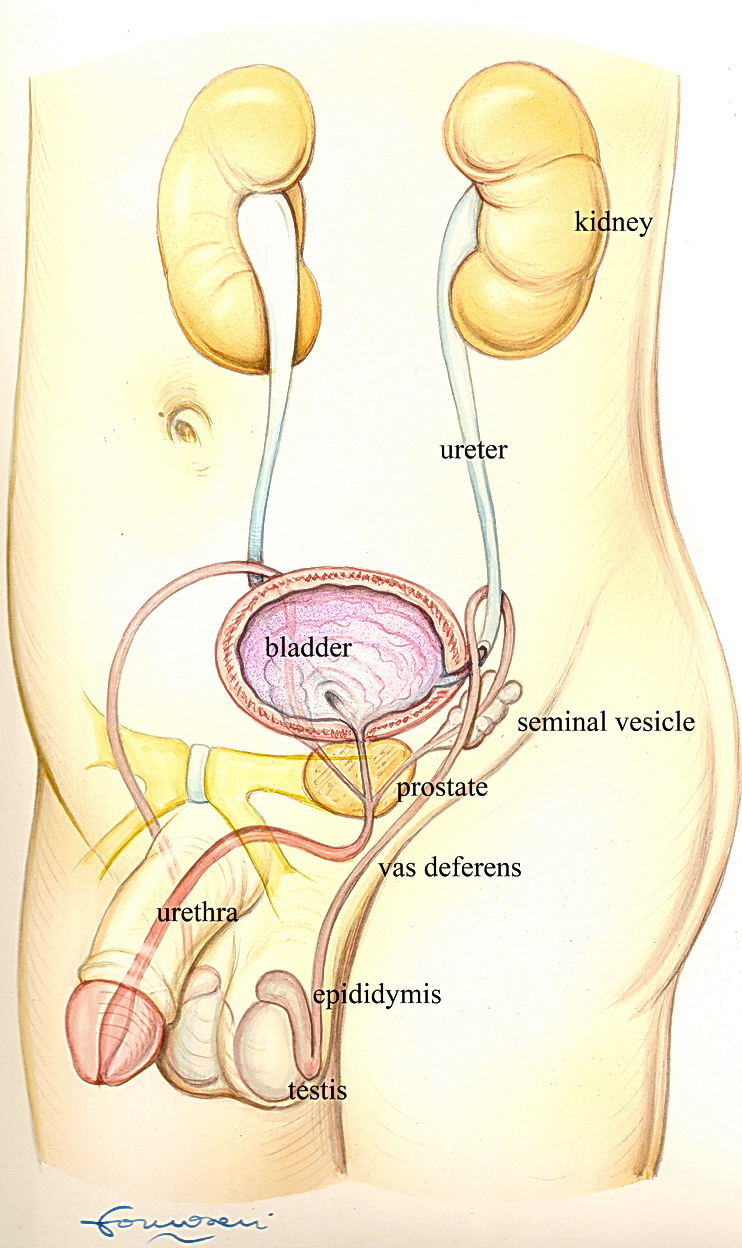
Cystitis
Cystitis is a bladder inflammation. Usually the onset is
acute. Bladder inflammation causes irritative symptoms,
including increased urinary frequency, suprapubic pain or
burden feeling, urinary burning sensation, at times with the
strong desire to void. Fever is possible. The urine can smell
unpleasantly. It is not rare to have haematuria (blood in the
urine). In elder patients the symptoms can be mild, or vague,
with mental confusion, fever, dizziness.
It usually affects female patients. About 20-40% of women
have at least one episode of cystitis during life.
Urine is secreted by the kidney through blood selective
filtration, and it is sterile. Cystitis is often due to
bacteria, that reach the bladder from outside environment.
Commonly the bacteria come from the vaginal mucosa. In the
majority of cases of cystitis, Escherichia Coli is the
bacterium involved.
Since the female urethra is a short channel (4 cm),
microorganisms can easily ascend from the vagina to the
bladder. The vagina is a cavity open to the external end. In
such anatomical conditions, it can´t be sterile, but it
always hosts germs; these germs are generally not pathogenic
for the genito-urinary tract, like lactobacilli. However, the
anus is anatomically so close to the vagina, that it is not
rare that bacteria coming from the bowel can easily reach the
vagina.
Some factors may contribute to increase the risk of cystitis.
An excess of local hygiene may mechanically wash out the
resident bacteria, and leave the field open to the infection
of new bacteria, for lack of biological competitors. The
vagina and anus should be washed separately, with the water
flowing in the direction from the vagina to the anus, and not
in the opposite direction, to decrease the risk of
contamination.
The menopause is related to a decreased estrogens
concentration and to a subsequent poor metabolism of vaginal
mucosa, with greater infection risk.
Intercourse may be a risk factor for cystitis. In fact, there
is an increased chance of carrying inside the vagina bacteria
from the genital skin. The massage exerted by intercourse on
the urethra may facilitate the bacteria of the vaginal mucosa
entering the bladder. Besides, the male semen itself is
potentially infective in case of recurrent vaginal
infections.
Congenital malformations of the lower genito-urinary tract my
also be a risk factor for cystitis..
In male patients, cystitis is more rare than in women, though
with aging the difference of incidence according to gender is
smaller. Major risk factors in male are incomplete bladder
voiding, due to obstructing prostate enlargement, or bladder
stones.
Of course an indwelling catheter is a source of bladder
infection.
In some Northern Africa and Middle East countries, some
urinary parasites (Bilharzia and Schistosoma) may be a cause
of cystitis.
The diagnosis is based upon symptoms, urinalysis, and urine
culture. In case of repeated or haemorrhagic cystitis, a
bladder ultrasound and a vaginal swab are advisable.
Uncomplicated cystitis may heal spontaneously within 3 days.
However, in case of severe symptoms or recurrent cystitis,
the acute treatment is based upon antibiotic therapy,
according to urine culture results. Antibiotic treatment must
be continued for 3 days, but it can last up to7 day for
complicated cystitis (haemorrhagic or with fever) or even 7
days in case of very weak or very ill patients.
The prevention is based upon removal or reduction of risk
factors.
When there is an estrogens deficiency, vaginal administration
of estrogens-based creams may be a reasonable option, unless
oncological contraindications subsist.
Interstitial cystitis is a particular condition with
suprapubic and/or pelvic pain, with increased urinary
frequency and voiding urgency. The incidence is between 2 and
7 cases per 100,000, according to the diagnostic criteria
used. It occurs mainly in women (9 cases out of 10), with a
peak of incidence at 40 years.
The diagnostic criteria are not standard, and the diagnosis
is often made when other possible underlying causes of the
symptoms have been excluded.
Though initial diagnosis criteria included ulcers at
cystoscopy and bleeding after bladder distension, today the
criteria are mainly based upon symptoms.
Altered bladder sensitivity may be involved in the disease.
In 75% of patients the symptoms are triggered by the
potassium test (instillation of a potassium solution in the
bladder)
The diagnostic role of bladder biopsy is controversial.
Medical therapy includes drugs that might protect the
integrity of the bladder wall, such as Pentosan polysulfate
sodium, heparin, ialuronic acid, or endovesical instillation
of DMSO (dimethyl sulfoxide). Some tricyclic antidepressants
(amitriptyline), antihistamines., or narcotic analgesic have
been proposed, with debatable symptom improvement.
Some authors have related interstitial cystitis to chronic
prostatitis, and chronic pelvic pain syndrome, and altered
potassium metabolism might be involved.
Experimental treatments with vitamin D3 analogues,
endovesical BCG, bladder, submucosal injection of botulinum
toxin have been all tried.
Transcutaneous Electrical Nerve Stimulation has been proposed
to relieve the pelvic pain. Mild electric tension is applied
on the pubic area or on the lower back. It may help to
decrease pain and urinary frequency. Often at least 3 months
of treatment are needed to obtain some benefit. Also sacral
nerve root stimulation, with permanently implanted
electrodes, has been experimented.
Invasive procedures can go from simple bladder distension,
under anaesthesia, to increase bladder capacity, to bladder
augmentation with a bowel segment, for patients with severely
contracted bladder.